

Mindfulness Archives - Atlantis | Tiptree

Breathwork Basics: Three Simple Techniques That Actually Work

Person practising calm deep breathing in soft natural light

Three Breathing Techniques for Stress (And How to Use Each)

Short answer Three techniques cover almost every situation. Box breathing (4-4-4-4) for general calm and focus — before a meeting, before bed, in the car park. Extended exhale (4 in, 6–8 out) for acute stress when you need to come down fast. Nasal-only breathing as a daily upgrade that quietly improves everything from sleep to gym sessions. None of them take longer than two minutes. All of them work because your breath is the one autonomic process you can consciously control.

Of all the wellness tools you can pick up, breathwork is the one you literally already own. You can do it at your desk, in the car park before a meeting, in bed at 3am, or mid-workout when your form starts wobbling. You don’t need an app. You don’t need a teacher. You don’t need to spend anything.

And unlike most wellbeing advice — which tends to ask you for six weeks of practice before paying out — the right breathing technique works in minutes. Not because it’s magic, but because it’s the only conscious lever you have on your own nervous system.

Why your breath is such a powerful lever

Your nervous system has two main settings. The sympathetic branch — fight, flight, do the thing now — revs you up. The parasympathetic branch — rest, digest, recover — calms you down. Most of modern life keeps the first one mildly switched on all day, which is why “a bit stressed but functional” has become so many people’s baseline.

Breathing is the only process your body does both automatically and consciously. Your heart rate, your digestion, your blood pressure — you can’t change them on purpose. But you can absolutely change your breath. And because the breath is wired into the same nervous system that governs all the rest of it, changing the breath changes everything else downstream.

Slow, deep breaths nudge you towards parasympathetic — calmer, steadier, more present. Quick, sharp breaths nudge you the other way. Knowing which to use, and when, is the whole skill.

The breath is the front door to the nervous system. Three techniques are enough to walk through it whenever you need to.

Technique 1: Box Breathing (for calm and focus)

Box breathing is used by everyone from Navy SEALs to overworked parents because it’s genuinely simple and it works reliably. It’s the all-purpose tool of the breathwork world.

How to do it

  • Breathe in through your nose for a count of 4
  • Hold the breath for a count of 4
  • Breathe out through your nose (or pursed lips) for a count of 4
  • Hold empty for a count of 4
  • Repeat for a minute or two. Five rounds is plenty if you’re short on time.

The four phases form a “box” — equal sides — which is where the name comes from. You can scale the count up or down depending on lung capacity. Some people find 5 or 6 feels more natural. The exact number matters less than keeping the four phases even.

When to use it

  • Before a difficult conversation or meeting
  • Before walking on stage or into an interview
  • The first ten minutes after sitting down at your desk in the morning
  • Right before sleep, lying in bed
  • Whenever you notice your jaw is clenched or your shoulders are at your ears

The first time you do it, you’ll feel your heart rate visibly settle. By the third or fourth round, your head usually feels clearer. By round five, you wonder why you don’t do this all the time.

Technique 2: Extended Exhale (for stress in the moment)

When you’re actually stressed — not low-grade buzzing, but genuinely heart-thumping, palms-sweating stressed — box breathing can feel like too much patience to summon. The extended exhale is the panic-button version.

The principle: when you breathe out for longer than you breathe in, you stimulate the vagus nerve. That’s the long nerve that runs from your brainstem down into your gut, and it’s the main physical channel between your conscious choices and your unconscious calm. A long exhale tells the vagus nerve, in effect, “we’re safe. Stand down.”

How to do it

  • Breathe in through your nose for 4 seconds
  • Breathe out, slowly, through your nose or pursed lips for 6–8 seconds
  • Don’t hold — just keep cycling
  • Continue for 1–2 minutes

The classic “4-7-8 breathing” you may have heard about is a version of this, with a hold thrown in. The hold is optional. The long exhale is the part that actually does the work.

When to use it

  • When you can feel adrenaline before you can name the trigger
  • After a near-miss in traffic
  • When you’ve just opened an email you didn’t want to see
  • 3am wakeups where your mind has switched on uninvited
  • Before any test, performance or moment that’s making your hands shake

Two minutes is usually enough to bring you down meaningfully. Five is enough to feel functionally yourself again.

Technique 3: Nasal-Only Breathing (the daily upgrade)

The first two techniques are tools for specific moments. This one is a lifestyle adjustment that quietly improves everything — sleep, exercise tolerance, focus, even immune function.

The simple ask: breathe through your nose more often. Including during easier exercise. Including, ideally, while you sleep.

Why this matters more than it sounds:

  • Nasal breathing filters and warms the air before it hits your lungs. Mouth breathing skips that step entirely, which is one reason chronic mouth breathers tend to catch more colds.
  • Your nose produces nitric oxide as you breathe through it — a gas that helps open your airways and improves how your body uses oxygen. Mouth breathing skips this too.
  • Nasal breathing naturally slows your pace because the airway is smaller. This regulates your breathing rate without you thinking about it.
  • It builds CO2 tolerance over time, which sounds technical but translates to feeling less out of breath during exercise.

How to practice it

Start small. While walking, try keeping your mouth closed and breathing only through your nose. If you have to slow down to maintain it, slow down — that’s the practice. Do the same on the bike or cross trainer on easy days.

For sleep, some people use mouth tape (gentle medical tape across the lips) as a training tool to encourage nasal breathing overnight. Sounds dramatic. Works remarkably well for people who wake up with a dry mouth or sore throat.

The unsexy truth about nasal breathing: You don’t need to do anything special. You just need to keep your mouth closed more of the time. That is genuinely the whole technique. Six weeks of doing this consistently is enough to feel a noticeable difference in your everyday energy.

Common breathwork mistakes

A few things people get wrong when they start:

  • Over-breathing. Forcing big dramatic inhales doesn’t calm you down — it usually does the opposite. The breath should feel relaxed, not effortful.
  • Counting too aggressively. If a 4-second inhale is uncomfortable, drop to 3. The point isn’t the count; it’s the rhythm.
  • Tensing the shoulders. Watch yourself in a mirror once. If your shoulders rise on every inhale, the breath is staying in your chest. Better breathing happens in the belly — your stomach should move out gently on the inhale.
  • Doing it once and expecting magic. Each session works in the moment, but the bigger benefits (lower baseline stress, better sleep) come from repetition. A few minutes a day for a few weeks beats one heroic 30-minute session.
  • Treating it like medicine. Breathwork helps with normal stress. It is not a replacement for professional help if you’re in genuine crisis or dealing with serious anxiety. Use it alongside, not instead of.

When to use which: a quick reference

  • Background stress, focus, sleep: Box breathing
  • Acute stress, panic, adrenaline: Extended exhale
  • Daily life, exercise, energy: Nasal-only

If you only learn one: extended exhale. It’s the most reliably powerful in the moments you most need it.

Using breath inside your training

The same principles apply at the gym — arguably more so, because exercise is when most people’s breathing falls apart.

  • Lifting: Breathe in on the lowering phase, breathe out on the effort phase. Never hold your breath on a heavy rep unless you’ve been specifically coached to (it raises blood pressure quickly).
  • Cardio: Try nasal-only breathing on easy cardio days — treadmill walks, bike, cross trainer at moderate pace. It’ll feel harder at first, then your tolerance builds and your effort feels lighter.
  • Stretching: Long, slow exhales deepen the stretch because the muscle releases more on the out-breath than the in-breath. The Stretch Mobility & Core, Yoga and Pilates classes at Atlantis all build this skill naturally.
  • Cool-down: Finish a session with two or three minutes of box breathing, ideally in the sauna or by the pool. The nervous system shift you build in those few minutes is what carries the calm into the rest of your day.

Breath for sleep specifically

If you’re reading this at 1am with your phone too close to your face, this section is for you.

The two breathwork tools for sleep:

  • Before bed: Five minutes of box breathing while lying down, eyes closed. Often this alone is enough to take you under.
  • If you wake in the night: Extended exhale — 4 in, 8 out, through the nose, quietly. The long exhale will gently bring you back towards sleep without the wakefulness spiral.

The aim isn’t to “force” sleep (forcing sleep is a great way to stay awake). It’s to take the pressure off the wakefulness — let your nervous system settle — and then let sleep arrive on its own.

And when you want to go deeper than self-practice

Sometimes you want guidance rather than going it alone. The slightly awkward truth about self-led breathwork is that you can’t fully relax while simultaneously being the person guiding the relaxation. Part of your attention has to stay “in charge.”

Reiki therapy with Sean at Atlantis is a calm, private hour where breath, stillness and deep relaxation come together in a way that’s hard to replicate on your own. Sean has thirty-plus years of practice, including time studying in China under Master Yu Tian Jian. People often describe their first session as the first time in years they’ve actually switched off — not just relaxed, but properly off.

And if you’d rather build breath awareness in a more familiar movement-based setting, the gentler classes on our timetable — particularly Yoga, Fitness Yoga and Stretch Mobility & Core — teach the same principles through movement.

A final small ask

If you read this far and didn’t practise even one technique, do this now: breathe in for 4, out for 6 or 7. Just once. Repeat three more times.

Notice anything different? Most people do. That’s the whole proof. Tools that work in 30 seconds are worth keeping in your pocket for the rest of your life.

Want help building a calmer, stronger weekly routine?

Call Atlantis Gym & Spa on 01621 816955 or pop into Chapel Road, Tiptree. We’ll talk through what might suit you — the gym, the pool, the classes, or a Reiki session with Sean.

Get In Touch
Meditation for Beginners: How 10 Quiet Minutes Can Change Your Week

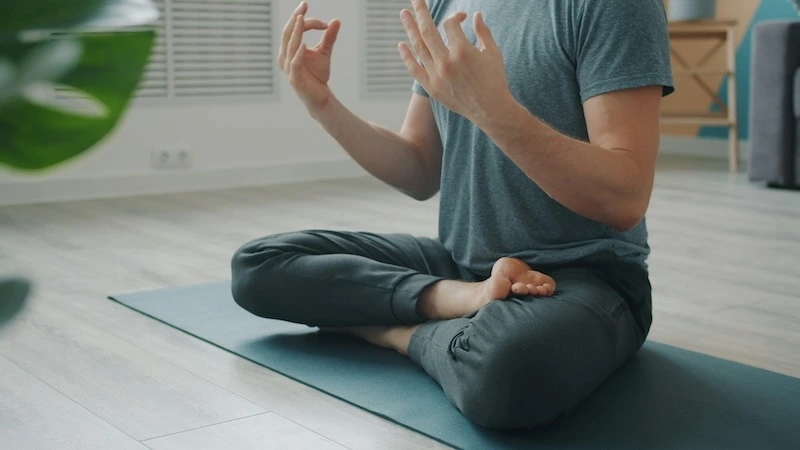
Person meditating quietly in a calm, softly lit space

How to Meditate for 10 Minutes a Day (And Why It Works)

Short answer Meditation is just paying attention — gently, on purpose — to one thing at a time. You don’t need to clear your mind, sit cross-legged, or buy anything. Ten minutes a day, sat in a normal chair, for two weeks, is enough to feel a real shift in stress, sleep and focus. Below: how to do it without any of the woo, what to expect in the first few sessions, what to do when your mind won’t shut up (it won’t — that’s normal), and a 14-day plan you can actually stick to.

Meditation has a bit of an image problem. For a lot of people it conjures up incense, cross-legged poses on a hardwood floor, and the suspicion that you’re supposed to “empty your mind” — whatever that means. There’s a vague sense that if you’re not vibrating at a higher frequency by the end of it, you’re doing something wrong.

The truth is much friendlier. Meditation is simply the practice of paying attention, gently, to one thing at a time. That’s the whole thing. And ten minutes of it, repeated daily, can quietly change the shape of your whole week.

What meditation actually is (and isn’t)

It isn’t about stopping your thoughts. Your thoughts will keep arriving — that’s what brains do. They produce thoughts the way a heart produces beats. Asking your mind to be empty is like asking your stomach to stop digesting. It’s not how the machine works.

The practice is much simpler: notice when your attention has wandered off, and quietly bring it back to whatever you’re focusing on. Usually that’s your breath. That tiny act — noticing, returning, noticing, returning — is the entire technique.

If you do that for ten minutes a day, you are meditating. Properly. Even if your mind wandered fifty times. Especially if your mind wandered fifty times.

Wandering and returning is the practice. Not the failure of the practice. The practice itself.

“But I can’t meditate — my mind is too busy”

This is the single most common objection we hear. It is also, ironically, the strongest possible reason to start.

If your mind feels busy — if you find yourself replaying conversations at midnight, mentally writing emails in the shower, or losing chunks of your day to anxious loops — you are exactly the person meditation was designed for. The busier the mind, the more useful the practice becomes.

People with calm, ordered minds don’t need meditation. They’ve already got the thing meditation is trying to teach. The rest of us — which is most of us — benefit precisely because we’re starting from chaos.

The misconception that “good meditators have quiet minds” is backwards. Good meditators have just as many thoughts as anyone else. They’ve simply learned a different relationship with those thoughts: noticing them, letting them pass, returning to the breath. The thoughts didn’t go away. They just stopped running the show.

Why it’s worth ten minutes a day

The research on regular meditation is robust enough that the NHS now lists it among its self-help recommendations for stress and anxiety. What the studies consistently find:

  • Lower baseline stress (measured by cortisol levels)
  • Improved sleep quality, particularly time-to-fall-asleep
  • Better focus and working memory
  • Reduced reactivity — the gap between a stressor and your reaction grows
  • Steadier mood, especially in people prone to low or anxious moods
  • Lower blood pressure with sustained practice

You don’t need to take anyone’s word for it. The deal you can offer yourself: ten minutes a day for two weeks. If nothing’s shifted by day fifteen, you’ve invested 140 minutes and lost nothing. If something has shifted — which it usually does — you’ve found a tool you can use for the rest of your life.

Most people report feeling a little less reactive and a little more present after a fortnight. That sounds modest until you live it. “Less reactive” means the email that would have ruined your morning doesn’t. “More present” means you actually taste your dinner. These are not small things.

A simple 10-minute starter

This is genuinely all you need. No app, no candle, no chanting.

  1. Sit comfortably. A chair is absolutely fine — better than a cushion, if you’re not used to floor sitting. Feet flat on the floor, hands resting in your lap, back relatively upright but not rigid.
  2. Close your eyes, or soften your gaze towards the floor a metre or so in front of you.
  3. Take three slower breaths to settle. In through the nose, out through the nose or mouth, slightly longer on the exhale.
  4. Let the breath return to normal. Don’t try to control it. Just notice it — the feeling of air at the nostrils, or the gentle rise and fall of the chest. Pick one of those and stay with it.
  5. When your mind wanders (it will, often, sometimes within five seconds), gently bring it back to the breath. No frustration. No commentary. Just “ah, wandered, back to the breath.”
  6. Carry on for ten minutes. Use a soft timer on your phone — an alarm with a gentle sound, not a klaxon.
  7. Open your eyes slowly when you’re done. Notice how you feel. Don’t leap straight into your phone.

What to expect in the first few sessions

Some honesty: the first few sessions might feel boring, or restless, or vaguely uncomfortable. This is normal and not a sign you’re bad at it.

Common first-week experiences:

  • Your mind feels busier, not quieter. It isn’t. You’re just noticing what was always there.
  • You feel sleepy. Your nervous system might genuinely be that tired. That’s information, not failure.
  • You feel restless or fidgety. Also normal. The urge to check your phone, scratch your nose or stand up will pass if you don’t obey it.
  • The ten minutes feels endless. Then suddenly, around day five or six, it doesn’t.
  • You feel emotional unexpectedly. Some people find that sitting quietly for the first time in years brings up feelings that were buried. This usually passes within a few sessions and is, gently, the point.
The unexpected gift of beginner meditation: The first time you notice your mind wandering and bring it back without getting annoyed at yourself, you’ve done something tiny but radical. You’ve made friends with your own attention. Everything in the practice is built on that single small moment, repeated.

Common stumbling blocks — and what to do

“I keep forgetting to do it”

The cure is habit-stacking: attach the meditation to something you already do without thinking. Right after your morning kettle boils. The first ten minutes after the kids leave for school. Right before bed, after teeth-brushing. New routines stick when they piggyback on existing ones.

“I fall asleep”

Either you’re very tired (which is information — sleep more) or you’re lying down to meditate. Sit upright. The slight effort of sitting keeps the system awake enough to do the practice without keeping it tense.

“Ten minutes feels too long”

Start with five. Genuinely. Three even. The number doesn’t matter compared to the consistency. Five minutes a day for thirty days will do far more than ten minutes once a week.

“My mind never settles”

It doesn’t need to. Re-read the section above. The practice isn’t a settled mind. It’s noticing the unsettled mind without being yanked around by it.

“I don’t know if I’m doing it right”

If you’re sitting quietly, returning your attention to the breath whenever you notice it’s wandered, and not punishing yourself for the wandering — you’re doing it right. That’s the whole technique. There is nothing more.

Morning or evening?

Either. Both, eventually, if you fall in love with it. But for starting out:

  • Morning tends to be better for people who want help with focus, mood and getting through busy days. It sets the tone before the day’s noise begins.
  • Evening tends to be better for people who struggle with sleep, evening anxiety, or carrying work home in their heads.

The honest answer: pick whichever time you’re more likely to actually do it. The best time of day is the one you’ll repeat.

A 14-day starter plan

If you want something structured to follow, this is the simplest plan that delivers results:

  • Days 1–3: 5 minutes a day, same time, same chair. Don’t aim for ten yet.
  • Days 4–7: 7–8 minutes a day. Same chair. Notice anything different yet?
  • Days 8–14: 10 minutes a day. By now the chair feels almost familiar.
  • Day 15: Reflect. Are you sleeping any differently? Reacting any differently? Most people say yes, in small but unmistakable ways.

If after two weeks the practice has done nothing for you, that’s rare but allowed — meditation isn’t for everyone, and there’s no moral failure in trying it and moving on. If it has done something, you now know how to give yourself ten minutes of calm whenever you need it. That’s a skill you carry forever.

When you want to go deeper

Once you’ve got a daily habit going, many people find guided experiences a brilliant next step. At Atlantis, our co-founder Sean has practised Reiki and meditation for over thirty years, including time lived and studying in China within the Esoteric Buddhist tradition under Master Yu Tian Jian.

His private Reiki sessions in Tiptree sit somewhere between meditation, deep relaxation and traditional energy work — a calm, grounding hour where you don’t have to do anything except let your nervous system settle. People often describe it as the first time in years they’ve actually switched off.

And if Reiki feels like a step further than you’re ready for, the gentler classes on our timetable — particularly Stretch Mobility & Core, Yoga and Fitness Yoga — build attention and breath awareness in a more familiar movement-based setting.

The small tip nobody mentions

Pair meditation with something you already do. The two minutes after you sit down with your morning cup of tea. The ten minutes before bed, after the dishes are done. The quiet half-hour after the school run when the house is still warm with everyone’s departure.

That’s where new habits actually stick. Trying to build a brand-new routine from cold is the part that usually fails. Anchoring it to a moment that already exists in your day is the cheat code.

A final permission slip

You don’t need a guru. You don’t need an app subscription. You don’t need to sit on the floor. You don’t need to believe in anything in particular. You don’t need to be calm before you start — the practice is the calming.

You just need ten minutes, a chair, and the willingness to keep returning your attention to your breath whenever it wanders. Which it will. Constantly. And that’s fine. That’s the whole thing.

Curious about meditation, Reiki, or a quiet hour to yourself?

Explore Reiki therapy with Sean at Atlantis Gym & Spa in Tiptree, or call us on 01621 816955 to talk about what might suit you. No pressure — just a conversation.

Learn About Reiki Sessions