
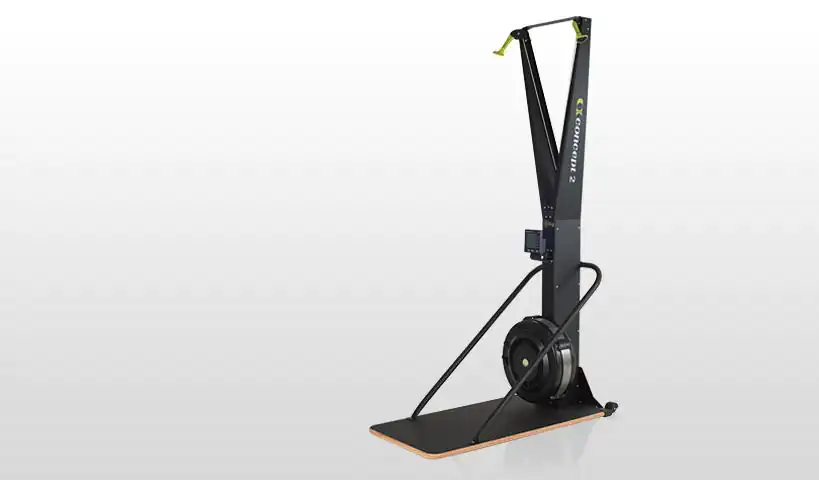
How to Use a SkiErg (And Why It’s the Cardio Machine You’re Missing)
If you’ve ever spotted the SkiErg in the corner of the gym and thought “no idea what that is, I’ll leave it,” you’re absolutely not alone. It’s one of the most under-used machines in any gym — and one of the best. People avoid it because it looks unfamiliar. The few who try it tend to become regulars surprisingly quickly.
The SkiErg deserves a slot in your weekly cardio mix for a list of reasons we’ll come to. But first — what it actually is.
What it actually is
The SkiErg was developed by Concept2 (the same people who make the rowers you see in every commercial gym) to mimic the pulling action of cross-country skiing — specifically the “double poling” technique elite skiers use to drive themselves up an incline. It’s used by professional Nordic skiers in their off-season training. It’s also been quietly adopted by CrossFit gyms, strength & conditioning coaches and rehab specialists across the world.
You stand in front of it, grip the two handles overhead, and pull down in a powerful, rhythmic movement that comes from your whole body. It looks unusual the first time you try it. Five minutes in, you understand why people love it.
Why it’s worth your time
- Full-body conditioning. Lats, shoulders, core, hips, legs all working together — not just an arm exercise despite how it looks.
- Huge calorie burn for the time spent. Per-minute calorie output rivals running and rowing for a fraction of the joint stress. A 15-minute SkiErg session genuinely counts.
- Low impact. Kind to knees, hips and ankles if running isn’t an option — or simply isn’t something you enjoy.
- Brilliant for HIIT. The machine is built for short, hard intervals. Easy to push hard for 20–30 seconds and recover.
- Upper-body cardio. This is the underrated bit. Most gym cardio is leg-driven — treadmill, bike, cross trainer. The SkiErg loads the upper body in a way that complements those machines beautifully.
- Reads instant performance feedback. Distance, time, watts, calories — the screen tells you exactly what you’ve done. Easy to track progression week to week.
How to use one (without looking lost)
- Stand close to the machine, feet roughly shoulder-width apart, knees soft.
- Reach up and grab the handles with arms straight overhead. Don’t grip too tight — a firm but relaxed hold.
- Pull down powerfully — think “punching the handles past your hips.” The pull goes from straight-overhead all the way down to your hips, not just halfway.
- Hinge at the hips as you pull, allowing your knees to bend slightly. The movement comes from the whole body, not just the arms.
- Let the cord retract smoothly as you return to the start position. Don’t fight the retraction — let the machine reset you.
- Reach up and repeat, falling into a steady, rhythmic pattern.
The thing that catches first-timers out is treating it like a pure arm exercise. It isn’t. The arms are the visible bit, but the power comes from the hips driving back and the core bracing as you pull. If your arms are killing you within 30 seconds, you’re relying on them too much. Pull from the lats and core, and the arms last much longer.
Three beginner-friendly workouts to try
1. The five-minute starter
30 seconds of steady, smooth pulling, then 30 seconds rest. Repeat for 5 rounds. Total time: 5 minutes.
Goal: get used to the rhythm and find your natural pace. Don’t worry about distance or watts the first time — just nail the movement.
2. The “I want to feel something” 10-minute session
1 minute moderate effort, 30 seconds hard, 1 minute moderate, 30 seconds rest. Repeat four times. Total time: 10 minutes.
Tough but short. The 30-second hard intervals should feel like an 8 out of 10. By the fourth round, you’ll know you’ve trained.
3. The conditioning finisher
After your strength session, do 4 rounds of 250 metres on the SkiErg with 60 seconds rest between rounds. Total time: 8–10 minutes flat.
A brilliant way to end a workout. The screen tells you the metres so you don’t have to think — just hit 250, rest, repeat.
4. The progression workout (when you’re ready)
For when the three above feel comfortable: 5 rounds of 500 metres at a target pace, with 90 seconds rest between rounds.
Pick a pace you can hold for all five rounds without falling apart. If you smash the first round and crawl through the last, the pace was too aggressive. The skill is finding a pace that’s repeatable.
Common mistakes to avoid
- Standing too far back. If your arms aren’t reaching fully overhead, you’re missing the top half of the movement. Step closer.
- Pulling with arms only. Drives early fatigue and lets your legs and core off the hook. Hinge at the hips.
- Yanking the cord. The pull should be powerful but smooth, not jerky. Jerky pulls are how you tweak a shoulder.
- Rounding your back at the bottom. Keep the spine relatively neutral as you hinge — don’t collapse forward.
- Death grip. Squeezing the handles too hard burns out your forearms. Firm grip, not crushing.
- Going all-out from rep one. Most beginners blow up in 60 seconds because they treat it like a sprint. Settle into a sustainable pace first; build intensity over weeks.
SkiErg vs rower: which should you use?
The most common question once people discover the SkiErg. Honest comparison:
The rower
Slightly more total muscle engagement (around 86% of body muscle mass per stroke). Strong leg drive. Familiar to most gym-goers. Easier to find a comfortable technique on. The default choice for general full-body cardio.
The SkiErg
More upper-body emphasis — particularly lats, shoulders and core. Standing position rather than seated, which loads the hips and posterior chain differently. Slightly harder to look natural on at first (because nobody’s ever taught it to you). Better for breaking out of treadmill-and-bike monotony.
The honest verdict
You don’t have to choose. Use both. They complement each other beautifully — row one session, SkiErg the next, and your weekly cardio mix is doing more for you than either alone. If you forced us to pick one for a desert island gym, we’d probably take the rower for slight versatility. But the SkiErg is where the most under-used cardio gains are hiding for most adults.
Who especially benefits from the SkiErg
- Desk workers — the overhead pulling action counteracts hours of forward-rounded shoulders
- Anyone with knee, hip or lower-back issues — low impact, gentle on the joints
- People who’ve plateaued on traditional cardio — the novel stimulus often kickstarts progress
- Strength lifters wanting conditioning — short SkiErg intervals are brutal without taking the legs out for the next leg day
- Boxing and combat sport athletes — the explosive pull pattern carries over to the ring
- Anyone who’s bored of the treadmill — variety is genuinely good for sticking with cardio long-term
Where it fits in your week
The SkiErg works beautifully as:
- A full cardio session in itself — 15–25 minutes of intervals once a week
- A replacement for a usual cardio session — swap one bike or rower day for SkiErg to break up the routine
- A 5–10 minute warm-up or finisher tacked onto a strength workout
- A short HIIT piece on days you don’t have time for a full session
If you mostly use the Workout Library sessions, try swapping the rower for the SkiErg every other week — the variety keeps you progressing instead of plateauing.
The SkiErg is part of the wider cardio area you can explore on our Gym-Apedia, alongside treadmills, rowers, bikes, ellipticals and the Jacobs Ladder. Each one has its place — the magic is mixing them across your week rather than living on one.
One last thing
The biggest barrier to the SkiErg isn’t the machine itself. It’s the moment of standing next to it in front of other people while you figure out the technique. That moment passes in about 90 seconds. After that, you’re just someone using a piece of gym equipment, the way you’d use any other.
Walk over. Have a go. Use the five-minute starter from above. By the end of your first session, you’ll know whether it’s for you. We’re willing to bet most of you will book a second go.
Want a hand learning the technique?
Just ask any of our instructors at Atlantis — that’s what we’re here for. A two-minute walk-through is usually all it takes to feel confident on the SkiErg. Call 01621 816955 or visit Atlantis Gym & Spa, Chapel Road, Tiptree.
Get In Touch