
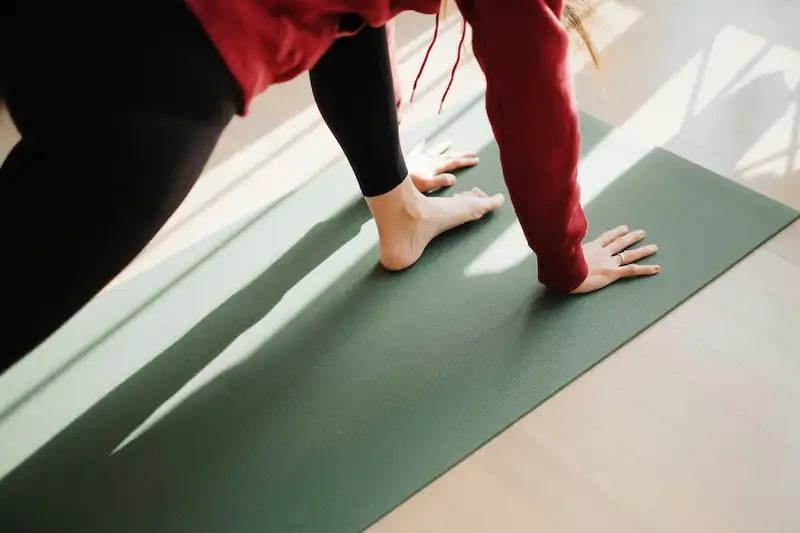
How to Improve Mobility (Without Spending Your Life Stretching)
If “flexibility” makes you picture someone effortlessly folding themselves in half on a yoga mat, you’re not alone. And that picture is exactly why most people quietly decide flexibility doesn’t apply to them. They’re not going to be doing the splits this year. Or any year, frankly. So what’s the point?
The point is that the picture is wrong. Mobility isn’t about looking impressive on Instagram. It’s the most overlooked piece of fitness for everyday adults, and the payoff isn’t visible in a mirror — it’s the difference between getting up off the floor easily at 50 and not, or reaching the top shelf without your shoulder complaining, or finishing a long day at a desk without your hips locking up.
This article is about the practical, unglamorous, genuinely useful version of mobility. Not the yoga magazine version.
Flexibility vs mobility — a quick translation
People use the words interchangeably. They’re different things, and the distinction matters.
Flexibility is how far a muscle can lengthen passively. If someone pushes your leg into a hamstring stretch, how far does it go before the muscle says stop? That’s flexibility.
Mobility is how well your joints actually move through their full range under your own control. Can you actively lift that leg as high as someone else can push it? That’s mobility.
You can be flexible without being mobile. Think of someone who can sit in the splits but struggles to do a proper bodyweight squat — the muscle length is there, but the control isn’t. Equally, you can be strong without being mobile — a fit, muscular adult whose hips have been locked at desk-height for fifteen years.
The sweet spot is both. Mobile and strong through that range. That’s what we’re aiming for. It’s also what protects you from the “I just turned funny and my back went” kind of injury that nobody warns you about until it happens.
Why it gets more important with age, not less
One of the persistent myths of getting older is that stiffness is just part of the deal. Achy in the morning? You’re fifty now. Knees a bit grumbly? It’s just age.
It usually isn’t. Stiff joints aren’t a sign of getting older — they’re a sign of not moving them through their range often enough. The body follows a brutally simple rule: use it or lose it. Joints that get moved through their full range regularly stay mobile. Joints that only get used in a narrow desk-and-driving range slowly lose access to the rest of it.
What regular mobility work actually buys you, especially after 40:
- Walking comfortably for long distances without lower-back grumbling
- Getting up off the floor without using your hands
- Reaching the top shelf without a shoulder twinge
- Sleeping through the night without rolling onto a sore hip
- Carrying shopping, kids, suitcases without pulling something
- Recovering faster after harder days at the gym, in the garden, or on holiday
- Significantly reducing the low-grade aches that creep in from desk-bound days
None of that involves the splits. All of it involves giving your joints a regular reminder that they can still go where they used to.
The four places stiffness shows up first
If you’re short on time and want to know where to focus, these are the four areas that quietly seize up first for most adults:
1. Hips
Sitting kills hip mobility faster than anything else. The hip flexors at the front shorten, the glutes at the back switch off, and the whole pelvis tilts in a way that pulls the lower back along for the ride. Hip mobility work is the single highest-return area for desk workers.
2. Upper back (thoracic spine)
The middle of your back is designed to rotate and extend. Hunching over a laptop teaches it to stay locked in flexion. Result: rounded shoulders, neck tension, and shoulder problems that look like shoulder problems but originate two segments lower.
3. Ankles
The most overlooked joint in the body. Ankle stiffness is why people can’t squat properly, can’t walk down stairs comfortably, and develop knee pain that’s actually an ankle problem. Trainers and supportive shoes have been quietly seizing our ankles for decades.
4. Shoulders
The most mobile joint in the body, and the most easily compromised. Phones, desks and steering wheels all encourage internally rotated, forward-rounded shoulders. Mobility work here restores overhead reach and protects against the rotator cuff problems that plague desk workers in their forties.
A simple test to know where you stand
Try these four quickly. Don’t force anything — just see what your body offers.
- Hips: Stand, lift one knee up to hip height and hold it without using your hands for 10 seconds. Repeat on the other side.
- Upper back: Sit on the floor, legs straight, back against a wall. Can you raise your arms above your head while keeping both hands flat to the wall behind you?
- Ankles: In a standing lunge, can you push your front knee forward past your toes while keeping your heel down?
- Shoulders: Reach one hand over your shoulder and down your back, and the other hand up your back from below. Can your fingers touch?
If any of those are uncomfortable or impossible — that’s the area to prioritise. Most adults will struggle with at least two. That’s normal, not a problem — just a starting point.
How much do you actually need?
Less than you’d think. Far less than the wellness industry would have you believe.
Ten focused minutes, three or four times a week, will move the needle meaningfully for most people. The body responds to regular, modest dose far better than it does to occasional heroic sessions. Three short sessions beats one hour-long stretch class, every time, because the joints need frequent reminders — not a single intense one.
The non-negotiable: consistency. Skip three weeks and you’re back to where you started. Stick to three sessions a week for two months and you’ll feel like you’ve borrowed someone else’s body.
A simple weekly mobility framework
Here’s a realistic structure most adults can actually keep up with:
- Two short stretching sessions at home — ten minutes each, focusing on hips, hamstrings, chest, upper back. In front of the telly is fine. Before bed is even better.
- One Pilates, Yoga or Stretch Mobility & Core class at Atlantis — properly programmed control and movement work, in a room with someone watching your form. Our classes page has the current timetable.
- Five-minute warm-ups before strength sessions — joint circles, dynamic movement, a light set of your first exercise. The Workout Library includes warm-ups built into every session.
- Optional: one swim or Aqua class — the water naturally encourages full-range movement with zero joint stress. Brilliant on days you don’t feel like the gym floor.
That’s it. Maybe 40 minutes of dedicated mobility work across the whole week, on top of training you’re already doing. The return on those 40 minutes is the rest of your year.
The exercises that actually move the needle
For each of the four problem areas, one go-to move that delivers more than its share of results:
- Hips: The 90/90 hip switch — sit on the floor with one leg bent in front, one bent behind, both at right angles. Switch sides by rotating through the hips. Two minutes a day. Genuinely transformative.
- Upper back: The foam roller thoracic extension — lie on your back with a foam roller under your shoulder blades, hands behind your head, and gently arch over the roller. Ten controlled reps.
- Ankles: The knee-to-wall — in a lunge, drive your front knee forward over your toes while keeping the heel planted. Twenty reps per side.
- Shoulders: Wall slides — stand with your back against a wall, arms in a goalpost shape, slowly slide them up and down keeping contact with the wall. Ten reps.
Pick the two areas you struggle with most. Do those moves daily for two weeks. Reassess.
Common mobility mistakes
Things that quietly waste your effort:
- Stretching cold. Hold static stretches before training and you’ll reduce your strength output for an hour afterwards. Use dynamic movement to warm up, save the static stretches for after.
- Holding too long. 30–60 seconds is plenty for most static stretches. Pushing past 2 minutes doesn’t add benefit and can irritate the muscle.
- Bouncing into the stretch. Ballistic stretching (bouncing) is a great way to tear something. Move into the position smoothly, hold, release.
- Stretching what’s tight without strengthening what’s weak. Tight hip flexors often mean weak glutes. Tight upper traps often mean weak lower traps. Stretching alone treats the symptom, not the cause.
- Mistaking discomfort for progress. A good stretch is mild discomfort, never pain. If you’re wincing, you’re going too far.
- Treating it as optional. The people who never “have time” for mobility are usually the same people who’ll spend six weeks recovering from a pulled hamstring. The maths doesn’t favour skipping it.
Don’t skip the warm-down
The five minutes after your workout — gentle stretching, slow breathing, a stroll on the treadmill — is where you bank tomorrow’s comfort. Not the day after a brutal session. The day after a normal one too.
What a proper warm-down actually does:
- Brings your heart rate down gradually, which helps with recovery
- Reduces the “blood pooling” that contributes to feeling lightheaded after intense work
- Gives your muscles a chance to lengthen back out before they cool in a contracted position
- Switches your nervous system from training mode back to normal mode, which helps with sleep that night
Add a sauna or steam session afterwards and you’re giving your body proper recovery rather than rushing back to the car park with stiff hamstrings. The spa facilities at Atlantis — pool, sauna, steam room and jacuzzi — are genuinely useful here, not just a nice-to-have. Heat exposure after training has been shown to improve recovery markers and reduce post-workout soreness.
A realistic starter plan
If you want a structured place to begin, here’s a fortnight you can run:
- Days 1, 3, 5, 7 (10 minutes each): 90/90 hip switch, foam roller thoracic, knee-to-wall, wall slides. That’s the whole session.
- Days 2 and 4: Your regular strength training, with a proper 5-minute warm-up at the start and 5-minute warm-down at the end.
- Day 6: Pilates, Yoga or Stretch Mobility & Core class at Atlantis.
- Day 7: Walk, swim, sauna, or simply rest.
Run that for two weeks. Take the same four mobility tests from earlier and see what’s changed. Most people are surprised.
What we see at Atlantis
The members at our gym in Tiptree who stay genuinely mobile into their fifties, sixties and seventies aren’t the ones doing heroic stretching sessions. They’re the ones who built small habits early — ten minutes a few times a week, a regular class on the timetable, a proper warm-down after training. The maintenance is quiet. The payoff is enormous.
The members who struggle are almost always the ones who treated mobility as optional. Then one day they bend down to tie a shoelace and something pings, and suddenly they’re very interested in mobility — just from a much worse starting point.
Be the first kind.
Want help building mobility into your routine?
Have a chat with our team about which classes and equipment would suit you. Call Atlantis Gym & Spa on 01621 816955 or visit us on Chapel Road, Tiptree. We’ve been helping people stay mobile for over twenty years — we know what works.
Get In Touch