
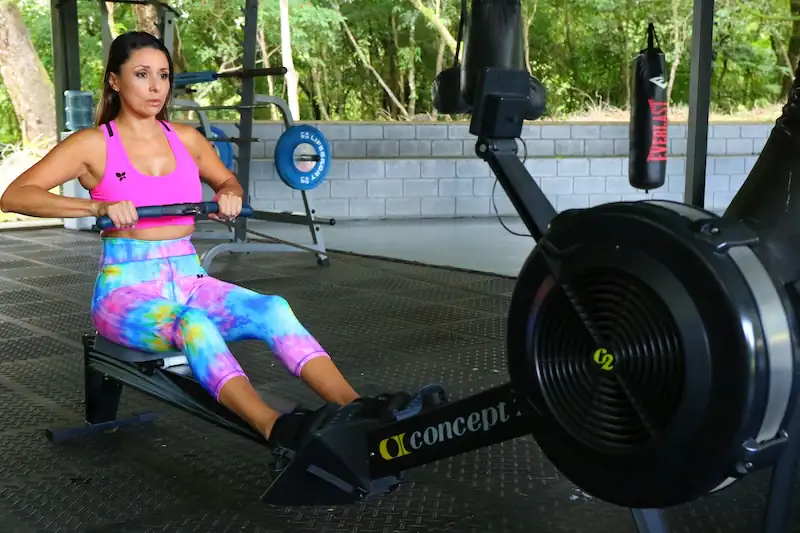
How to Use a Rowing Machine Properly (The Technique Fix That Changes Everything)
If you could only have one cardio machine, the rower would be a serious contender for the top spot. It works your whole body, builds cardiovascular fitness, supports posture, and is famously efficient — you can do real, productive cardio in fifteen minutes. It loads the back and lats in a way that desk-bound bodies genuinely need. And it scales beautifully from a gentle five-minute warm-up to a brutal twenty-minute test of character.
The catch: most people row with technique so bad it makes the machine feel pointless. They yank with their arms, drag their legs, hunch their backs, and finish each session convinced they’re “not really a rowing person.” They’re not wrong about the experience — just wrong about the cause. With proper technique, the rower transforms from frustrating to genuinely brilliant. And the fix is much simpler than it looks.
Why the rower deserves more love
- Around 85% of your muscles working per stroke. Legs, glutes, core, back, lats, shoulders, arms — all involved. Far more than any “cardio” machine that uses just your legs.
- Low impact. No pounding on knees, hips or ankles. You can row hard for years without joint stress catching up with you.
- Builds the posture muscles. The pulling movement is exactly what desk-bound bodies need — lats, mid-back, rear shoulders, all the muscles weakened by hours in front of a screen.
- Big calorie burn per minute. Per-minute, it’s one of the highest calorie outputs of any cardio machine, particularly during intervals.
- Genuinely scales. Gentle steady rows for endurance, all-out 30-second intervals for conditioning, anything in between for general fitness. Same machine, different effort.
- Honest feedback. The screen tells you distance, time, pace and stroke rate every second. Easy to track progress week to week.
The technique fix that changes everything
The rowing stroke is 60% legs, 20% core/hips, 20% arms — in that order. Most people do it the opposite way round (yanking with the arms, dragging with the legs), which is why their back aches and their times are slow.
The breakdown comes from competitive rowing coaching where it’s been refined over a century. Elite rowers don’t pull with their arms. They drive with their legs. The arms only finish what the legs started.
The four phases of the rowing stroke
- Catch. Knees bent, shins vertical, arms straight out in front, body leaning slightly forward from the hips. You’re fully compressed, ready to drive.
- Drive. Push hard through your legs first. Arms stay straight. The handle moves because your legs are extending, not because your arms are pulling.
- Finish. As your legs straighten, lean back slightly from the hips, then pull the handle to your lower ribs. The arms are the last 20% of the movement, not the first.
- Recovery. Reverse the order: arms extend forward first, then the body hinges forward from the hips, then the knees bend to slide you back to the catch. Smooth and slow — the recovery should take about twice as long as the drive.
The killer cue, the one that fixes most rowers in about thirty seconds: legs, body, arms on the drive. Arms, body, legs on the recovery. Say it out loud the first few times. It clicks.
Common rowing mistakes (and how to spot them)
- Arms-first pulling. If your shoulders are doing all the work and your legs feel underused, you’re reversing the sequence. Drive the legs first, hard. The arms barely matter.
- Rounded back at the catch. If you’re hunched forward with a curved spine at the front of the stroke, you’re reaching with your shoulders instead of hinging from the hips. Keep the chest up and lean from the hips, not the upper back.
- Rushing the recovery. The recovery should be roughly twice as long as the drive. If you’re flying back to the catch at the same speed you drove, you’re burning energy with no purpose. Slow down on the way forward.
- Pulling too high. The handle should come to your lower ribs, not your collarbone. Pulling to the chin engages the wrong muscles and looks like the universal sign of someone who learned to row from a music video.
- Knees collapsing inward. If your knees fall toward each other on the drive, you’re losing power and risking the joints. Drive knees outward, in line with toes.
- Death grip on the handle. A relaxed, hooked grip is enough. Squeezing the handle white-knuckled wastes forearm energy and tightens your shoulders.
- Stroke rate too high. Beginners often try to row at 30+ strokes per minute. Real, efficient rowing happens at 20–26 strokes per minute. Slower, more powerful strokes beat fast, weak ones every time.
How to read the screen
The Concept2 monitor on most rowers shows four main numbers. Quick translation:
- Distance: how far you’ve rowed in metres. The clearest progress metric over time.
- Time: session length.
- Split (per 500m): the most useful number on the screen. It shows how long it would take you to row 500 metres at your current pace. Lower is faster. Most adults sit between 2:00 and 2:45 for steady rowing.
- SPM (strokes per minute): how often you’re completing a full stroke cycle. Aim for 20–26 for steady work, 28–32 for intervals. If you’re at 35+, you’re flailing.
The trick: focus on split, not strokes per minute. A slow stroke rate (22 SPM) with a strong pull will produce a faster split than a fast stroke rate (32 SPM) with weak pulls. Power per stroke beats speed of strokes, every time.
Three rower workouts to try this week
1. The smooth 10-minute starter
Row at a steady, conversational pace for 10 minutes. Goal isn’t speed — it’s nailing the rhythm and technique. Aim for 20–24 strokes per minute. Keep the split consistent. Don’t fade.
Repeat 2–3 times a week. By week three, your steady split will have dropped 10 seconds without you trying.
2. The 500m intervals
Row 500m hard, then rest 90 seconds. Repeat 4 times.
Note your times — and try to keep all four within 5 seconds of each other. The skill is pacing, not just flat-out effort. Brilliant 15-minute workout that delivers in well under 20.
3. The “I’m short on time” combo
Alternate 250m row with 10 press-ups, for 5 rounds.
Full-body, lung-burning, and done inside 15 minutes. The press-ups feel disproportionately hard after the row — that’s the point.
4. The 2k test (for benchmark days)
Once every 6–8 weeks, row 2,000 metres at maximum sustainable effort. Record your time. This is your benchmark.
Pace it: start at a pace you can hold, not your sprint pace. The middle 1,000m is the hardest section. The last 500m is where you push. If you’ve paced it right, you should be unable to talk at the end.
Rower vs treadmill: the honest comparison
The most common question once people get serious about cardio.
The treadmill
Familiar. Effective. Higher impact (so harder on joints over time). Mostly legs. Standing all session. Good for outdoor running carry-over.
The rower
Full-body. Low impact. Posture-supportive. Higher calorie burn per minute at matched effort. Less familiar (so the learning curve is steeper). Better for desk workers, joint-sensitive people, and anyone wanting upper-body involvement.
The honest verdict
For pure cardio fitness, both work. For total-body fitness, recovery from desk work, and time-efficient burn, the rower wins on a per-minute basis. For people who specifically enjoy running or are training for a 5k, the treadmill wins because of carry-over.
Most members at Atlantis benefit from both in their week. The treadmill on days they want lower-skill, podcast-friendly cardio. The rower on days they want a shorter, harder, more complete session. The mix is the answer.
Where it fits in your training
The rower is brilliant as:
- A warm-up — 5 minutes easy, gets the blood moving and the lats firing before strength work
- Your main cardio day — 20–30 minutes steady, or 15 minutes of intervals
- A finisher after lifting — 5 minutes of moderate rowing locks in the calorie burn
- A test of fitness — the 2k row every couple of months tells you how your overall fitness is progressing
- A wet-weather substitute for running — same cardiovascular benefit without the rain
The rower is a core part of the cardio equipment at Atlantis and pairs particularly well with the strength sessions in our Workout Library — Steady Stamina Builder, SkiErg & Rower Intervals, and the Calorie-Burn Circuit all use it.
How long it takes to improve
Honest expectations:
- Week 1–2: Technique starts to feel less awkward. You stop having to think about the leg-body-arm sequence.
- Week 3–4: Your steady split drops noticeably. Sessions feel easier at the same pace.
- Week 6–8: Real fitness gains. The 2k benchmark starts to fall. Your endurance under load improves across every other gym session too.
- 3 months in: You’re a competent rower. The technique is automatic. You’ve probably knocked 20+ seconds off your 2k.
It’s one of those rare skills where small consistent work produces visible, measurable improvement on a screen in front of you. That feedback loop is genuinely motivating.
Not sure your technique’s right?
Grab a member of the team for a quick check — five minutes can transform how rowing feels. We’ve been coaching this for over twenty years in Tiptree. Call 01621 816955 or visit Atlantis Gym & Spa, Chapel Road, Tiptree.
Get In Touch