
Sauna, Steam and Jacuzzi: Why Heat Recovery Actually Works
There’s a quiet shift happening in fitness, and for once it’s good news for anyone who likes taking it easy: recovery is finally being treated as part of training, not a guilty afterthought. The performance science world — the people who actually work with elite athletes — have known for years that what you do between sessions matters as much as what you do during them. The rest of us are catching up.
And it turns out the sauna, steam room and jacuzzi you might have written off as a “nice extra” in our spa area are doing real, measurable work. Not just for muscle soreness — for cardiovascular health, sleep quality, stress regulation, and the mental break that makes any kind of consistent training possible.
Here’s what’s actually happening, and how to use it properly.
Your muscles grow on rest days, not session days
When you train, you create small amounts of muscle stress — tiny tears in the tissue, depletion of energy stores, accumulated by-products of hard work. The adaptation, the bit where you actually get stronger and fitter, doesn’t happen during the workout. It happens afterwards, while your body recovers and repairs.
Skipping recovery is a bit like baking a cake and taking it out before it sets. The ingredients were right, the heat was right, but you didn’t give it the time to become what it was supposed to become. The session created the stimulus. The recovery makes it count.
This is why the people who train hardest are often the ones who progress slowest. Their bodies never get the chance to adapt before the next stress arrives. The trick is to train hard and recover well — not pick one and skip the other.
What heat actually does for the body
The research on regular sauna use is genuinely impressive, and not the soft kind — it includes long-term studies of thousands of adults followed for decades. The findings are consistent:
- Improved circulation. Heat expands blood vessels, pushing more oxygen and nutrients to muscles and helping clear the by-products of training that contribute to next-day stiffness.
- Reduced muscle soreness. Post-workout heat exposure measurably reduces delayed-onset muscle soreness (DOMS) compared to no recovery intervention.
- Cardiovascular benefit. Regular sauna use has been linked to lower risk of cardiovascular disease in long-term population studies. The Finnish research on this is particularly robust — they’ve been studying their own national sauna habit for years.
- Improved sleep. The body cools rapidly after heat exposure, and that drop in core temperature is one of the strongest signals your brain uses to initiate sleep. Many people find an evening sauna session gives them noticeably better sleep that night.
- Heat shock proteins. Regular heat exposure stimulates the production of proteins that help cells recover from stress — useful for muscle repair, but also linked to longevity research.
- Stress hormone reduction. Time in the sauna lowers cortisol and increases the relaxation response. Twenty minutes in the heat does what an hour of trying to consciously unwind often can’t.
None of this is mystical. It’s straightforward physiology, well-documented, increasingly mainstream.
Sauna vs steam vs jacuzzi: what’s the difference?
The three feel similar from the outside — warm, relaxing, mildly indulgent. They do different things.
Sauna (dry heat)
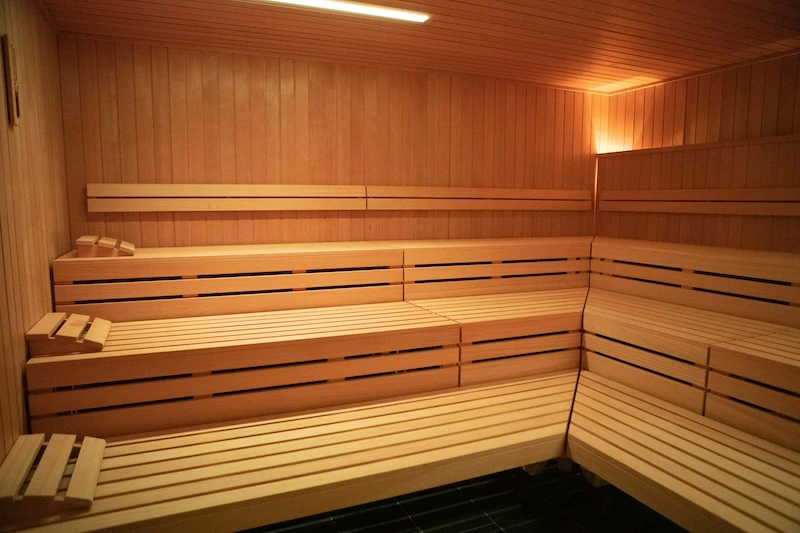
Typically 70–90°C, low humidity. The dry air lets your body sweat efficiently, which is the main mechanism for the cardiovascular and recovery benefits. Most of the strongest research findings come from sauna specifically. Best for: post-training recovery, cardiovascular conditioning, sleep, deep stress release.
Steam room (wet heat)
Lower temperature (40–50°C), close to 100% humidity. The wet heat is gentler than a sauna and easier to tolerate for longer, with particular benefits for the respiratory system — congestion, sinus tension, dry winter air. Best for: respiratory comfort, gentler recovery, post-illness wind-down, hot-skin afterglow.
Jacuzzi (hot water immersion)
Warm water with jets, typically around 37–40°C. The hydrostatic pressure of the water itself reduces swelling and supports the cardiovascular system in a different way to dry heat. The jets provide soft muscular massage. Best for: muscle soreness, joint aches, lower-back stiffness, post-cardio loosening.
The combined effect
The classic spa sequence — sauna, then jacuzzi, then a few minutes in the steam — gives you the benefits of all three. Most members at Atlantis find their own rhythm within a few visits. There’s no “correct” order, just whatever feels best after the kind of session you’ve done.
The underrated mental side
Heat bathing is one of the few moments in a busy day where there’s genuinely nothing to do but sit still. No phone (it doesn’t like the heat anyway). No to-do list. No screen. No conversation, unless you want one. For a lot of people that ten-minute pause is the most valuable part of the whole visit.
It’s also one of the few socially acceptable ways for adults to do nothing in modern Britain. Sitting on the sofa with your eyes closed for fifteen minutes in the middle of the day feels indulgent. Sitting in a sauna for fifteen minutes is just “recovery,” which makes it permissible.
This matters more than people realise. A nervous system that’s constantly stimulated — emails, notifications, traffic, family logistics, work pressure — needs structured downtime to recalibrate. Heat bathing provides exactly that, in a way that’s harder to skip than “just trying to relax at home.”
It’s also a big reason why the gym becomes a place people want to be rather than a chore. The session is the work; the spa is the reward built into the same visit. Your brain learns to associate the whole experience with feeling good, not just effort.
How to use it well
Practical guidance for getting the most out of it:
- Train first, recover after. Heat before training reduces your strength output and makes the session feel harder than it should. Use it as the wind-down, not the warm-up.
- Hydrate properly. You lose fluid in the sauna and steam — sometimes a lot of it. Bring water. Drink before, during and after. A pinch of salt in the water afterwards isn’t a bad idea if you’ve sweated heavily.
- Short, regular sessions beat one marathon sit. 10–15 minutes in the sauna is plenty for most adults. Pushing to 30+ minutes doesn’t add benefit and can leave you feeling drained for the rest of the day.
- Cool down between sessions. If you’re doing multiple rounds, a short cool-down (cold shower, brief pool dip) between rounds is genuinely useful. The contrast itself is part of the benefit.
- Pair it with a swim. A 20-minute easy swim followed by sauna and steam is one of the best “active recovery” days you can have — gentle on the body, restorative for the mind, and it absolutely counts as having shown up.
- Don’t use it when you’re ill, very dehydrated, or pregnant without checking with your GP first. Most of the time it’s fine. Some of the time it isn’t.
Common mistakes
- Staying too long. If you’re lightheaded leaving the sauna, you went over your limit. Build up gradually.
- Eating a huge meal beforehand. Heat shunts blood toward the skin to cool you, which interrupts digestion. Light snack at most.
- Drinking alcohol around it. Alcohol and heat are both dehydrating. Combined, they’re a recipe for feeling awful. Save the drink for later or skip it entirely.
- Skipping the cool-down at the end. Going straight from sauna to a hot car park leaves your nervous system unsettled. Allow 5 minutes of normal-temperature sitting before driving anywhere.
- Bringing a phone in. Apart from the device damage, it defeats the purpose. Leave it in the locker.
- Treating it as optional. If you’ve paid for spa access and only use it occasionally, you’re leaving most of the value on the table. The benefits come from consistency, not one-off visits.
Who especially benefits
- Strength trainers — faster recovery between hard sessions, reduced next-day soreness
- Endurance athletes — cardiovascular adaptation similar to (and additive with) cardio training itself
- Desk workers — the heat-induced relaxation counteracts a day of low-level stress and physical tension
- Older adults — gentle on joints, cardiovascular benefits, sleep improvements all matter more with age
- Anyone with sleep issues — evening sauna sessions are one of the most reliable, drug-free sleep aids available
- People going through stressful periods — the nervous system reset is genuinely restorative
- Anyone recovering from minor illness — steam is particularly good for the respiratory system after a cold
- Adults who need permission to do nothing — honestly, most of us
The Atlantis spa
Our spa area — large swimming pool, jacuzzi, sauna and steam room — is here to take you away from the stresses of everyday life, whether you’ve just trained hard or simply need an hour to yourself. Some of our members come purely for this, and that’s absolutely fine by us — the Spa Only membership exists precisely because not everyone wants the full gym, but plenty of people want the recovery facilities.
It’s also one of the most genuinely “wellness” spaces in mid-Essex without the resort price tag. A regular spa habit costs less than two coffees a day at most chains. Used three times a week for a year, the effect on how you feel is meaningful.
The honest bottom line
Heat recovery isn’t magic. It’s just a tool — a well-studied, evidence-supported, surprisingly enjoyable tool that complements training in ways most people underuse.
If you’re already training and you’ve got access to a sauna and steam, you’re missing real value by skipping them. If you’re not training but you’ve got access to them, you’re missing a different kind of value — the daily-life stress relief that adults rarely make time for.
Either way, the cost of adding 20 minutes of heat to your routine a few times a week is small. The cumulative benefit is real. The brain-pause alone is worth it.
Want to make recovery part of your week?
Ask about our Spa Only and full memberships at Atlantis Gym & Spa. Call 01621 816955 or visit us on Chapel Road, Tiptree. Pop in for a look around — the spa space speaks for itself once you’re standing in it.
See Membership Options